
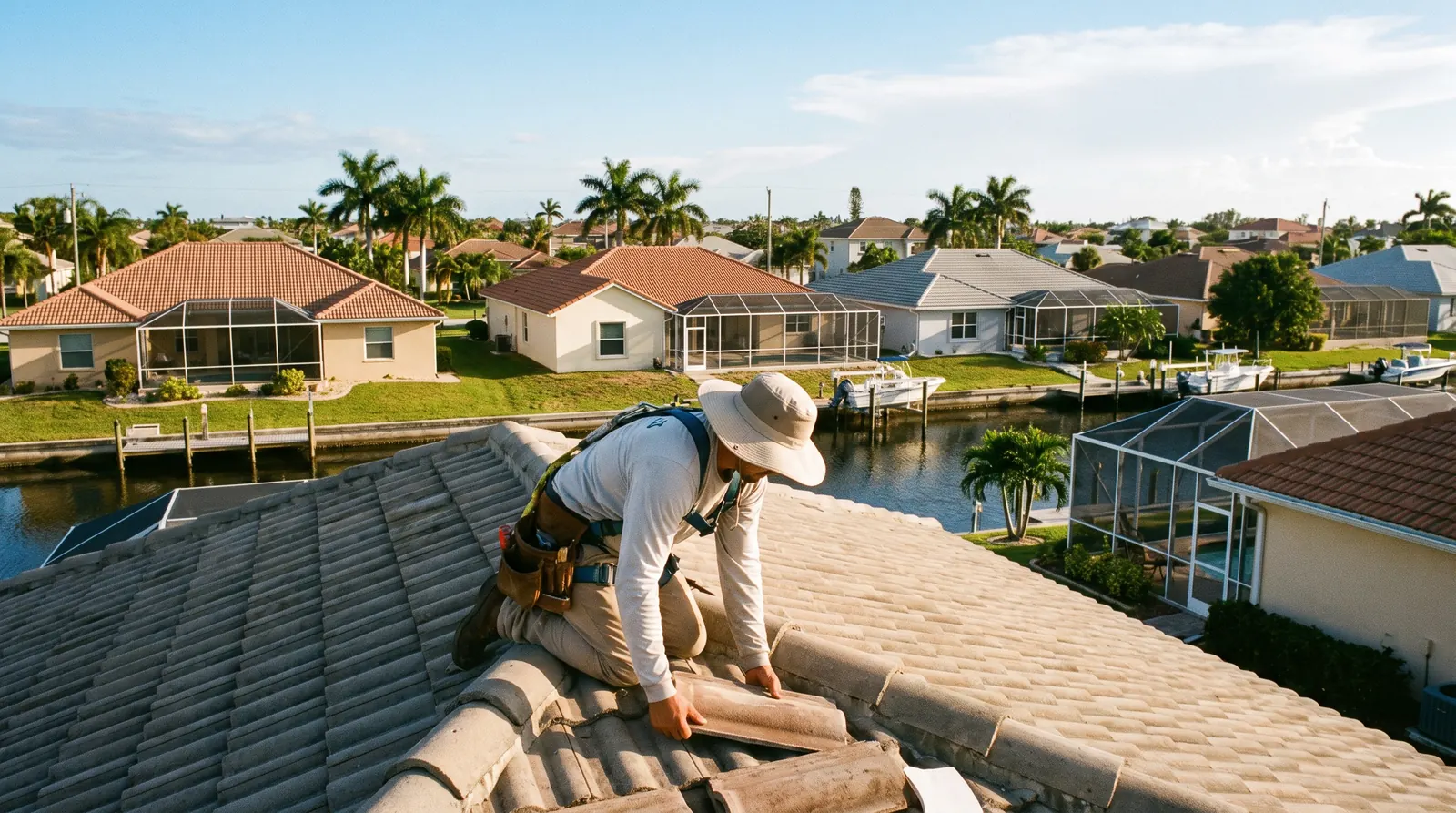
Roof Flashing Repair
Flashing Repairs for the Joints Where Roofs Leak Most
Seeing stains near a wall, skylight or the lanai roof? Call us and request a free estimate.
- Tile, shingle, metal and flat roofs
- Written estimate before work
- Repair-first recommendations
Get your free estimate
Tell us what's going on. We call you back fast.
Why Flashing Fails Near the Gulf Coast
Flashing is the metal, and sometimes membrane, that seals the joints in a roof: where it meets a wall, where two slopes form a valley, around pipes and skylights, and along the edges. The roofing sheds water across open areas, but these joints are where water most often finds a way in.
Cape Coral is hard on flashing. Salt air from the canals and the Gulf speeds up corrosion of metal and fasteners, intense sun breaks down sealants, and wind-driven rain tests every seam. Most homes are concrete block with stucco walls, and the joint where a roof slope meets a stucco wall is a frequent leak point once its flashing or sealant breaks down.
Roof flashing repair in Cape Coral is often a small, precise job that stops a leak that seemed impossible to find. We identify which joint is failing, replace or rework the flashing, and put the roofing back so water flows over the joint rather than into it.
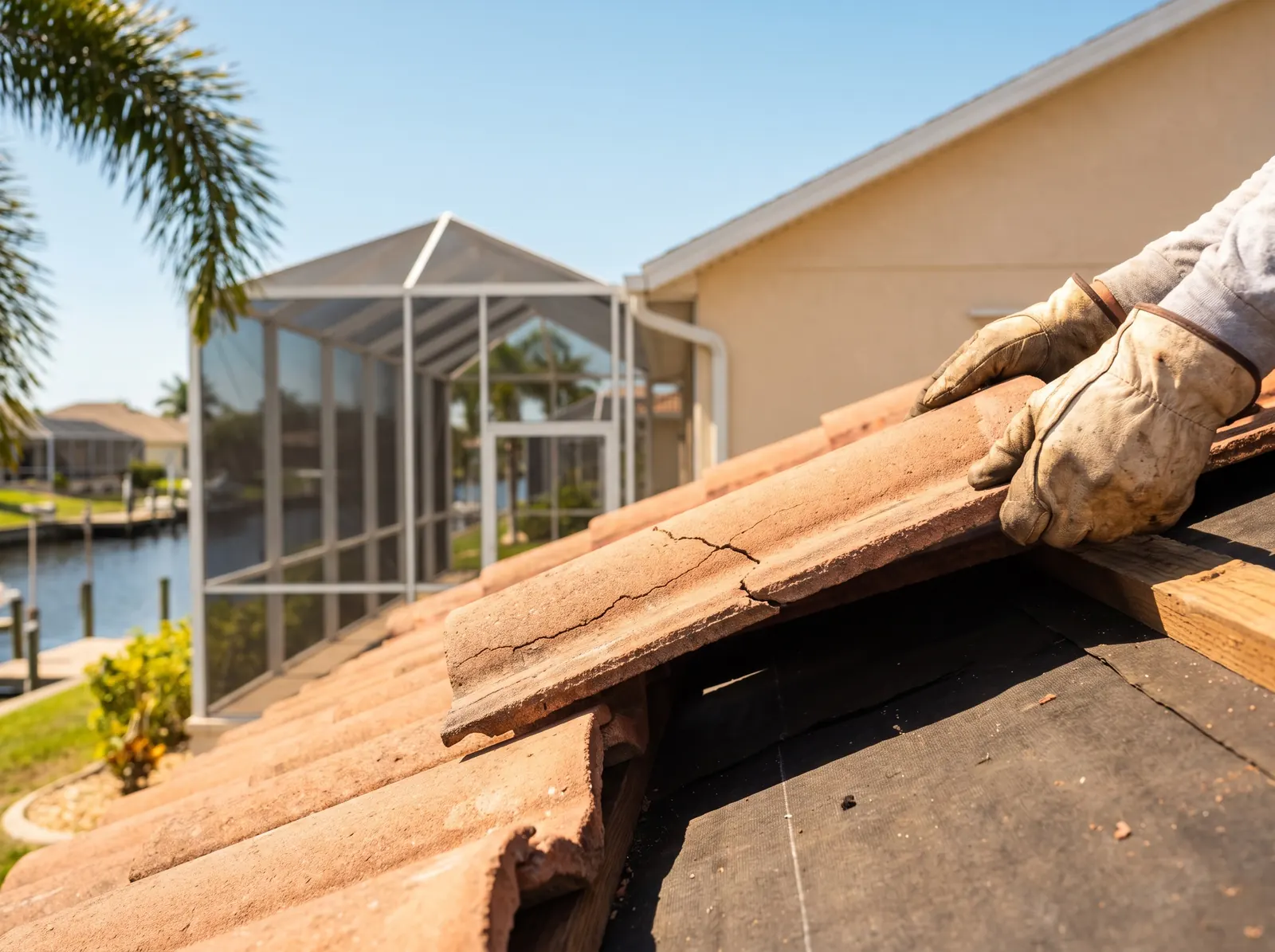
Flashing Repairs on Cape Coral Roofs
Each type of flashing does a different job, and each fails in its own way. These are the areas we check and repair most often.
Wall and step flashing at stucco walls
Where a roof runs into a second-story wall, a parapet or an addition, flashing has to tuck under the stucco or be covered by counterflashing. Cracked stucco, failed sealant and a missing kick-out at the bottom of the wall let water behind the finish and into the framing.
Valley metal
Many tile and shingle roofs use metal in the valleys. Debris holds moisture against it, salt speeds corrosion, and over time the metal can rust through or shifted tile edges can block the flow. We clean, repair or replace the valley metal and reset the roofing along it.
Pipe, vent and skylight flashing
Every opening in the roof needs flashing that steers water around it. Rusted vent flashing, cracked sealant at skylight curbs and disturbed lead around pipes on tile roofs are some of the most common repairs we make.
Drip edge and eave metal
Drip edge guides water off the roof edge and protects the fascia. When it corrodes or works loose, water wicks back into the fascia and deck, causing rot along the eaves.
Lanai and enclosure tie-ins
Where a flat lanai roof or a screen enclosure connects to the house, flashing and fastener holes have to be sealed carefully. These transitions move with wind and heat and often need resealing or new metal.
Headwall and sidewall flashing under tile
On tile roofs, the flashing at headwalls and sidewalls sits beneath the tile and is easy to overlook. When it rusts or was never lapped correctly, leaks appear under tiles that look perfectly fine.
Pricing
Roof Flashing Repair Price Ranges
| Repair type | Typical range | What moves the price |
|---|---|---|
| Resealing or re-securing existing flashing | $200 – $600 | Length of the joint, roof access, sealant type |
| Pipe or vent flashing replacement | $200 – $650 | Roof material, tile removal, number of penetrations |
| Wall or step flashing replacement | $500 – $1,800 | Length of wall, stucco repair needed, roofing removed |
| Valley metal repair or replacement | $600 – $2,200 | Valley length, tile or shingle reset, extent of corrosion |
| Drip edge or eave metal replacement | $400 – $1,500 | Linear feet, fascia repair, gutter removal |
These are planning ranges only, not quotes for a specific roof. The price depends on how much roofing has to be lifted to reach the flashing, whether stucco or fascia needs repair, and the metal used. We give you a written estimate before work starts.
How it works
Our Roof Flashing Repair Process
- 1
Describe the leak or the damage
Call and tell us where you see staining, rust streaks or loose metal. Leaks near walls, skylights or the lanai roof often point us straight to a flashing joint.
- 2
Inspect the joints
We check the suspect flashing and the joints around it, lifting tile or shingles only where needed, and look at the attic or ceiling below where possible.
- 3
Explain and estimate
We show you the failed joint and explain the repair, including any stucco, fascia or roofing that has to come off and go back on. You receive the scope and price in writing.
- 4
Repair the flashing
Old, corroded metal is removed, new flashing is installed with the correct overlaps and fasteners, and the roofing is reset over it.
- 5
Water test where practical
Where it makes sense, we run a hose over the repaired joint to confirm it sheds water, and we tell you what to watch for in the next storm.
Why Choose Us for Roof Flashing Repair?
Joint-by-joint diagnosis
Flashing leaks can travel along framing and show up far from the joint. We follow the water back to the specific seam that is failing instead of smearing sealant on every joint in sight.
Metal chosen for salt air
Close to canals and the Gulf, ordinary steel flashing and fasteners corrode fast. We discuss corrosion-resistant metals and fasteners that suit your location and roof.
Proper laps, not just caulk
Sealant helps, but a flashing repair should shed water by the way the pieces overlap. We correct laps and counterflashing so the repair does not depend on caulk alone.
Stucco and roofing coordinated
Wall flashing repairs often involve the stucco. We explain what needs to be opened up and how the wall will be closed again, so the scope holds no surprises.
Questions
Roof Flashing Repair FAQ
How do I know if a leak is coming from flashing?
Leaks that show up near a wall, skylight, vent or where two roof sections meet are often flashing problems. Rust streaks on stucco or loose metal along the roof edge are other clues. An inspection confirms which joint is failing.
Can flashing just be caulked?
Sealant can extend the life of sound flashing for a while, but caulk alone tends to crack and pull away in strong sun within a few seasons. A lasting repair relies on metal that overlaps correctly so water runs away from the joint.
Does flashing corrode faster near the canals?
Yes. Salt and brackish water in the air speed up rust on metal flashing and fasteners. Canal-front homes in Cape Coral often benefit from corrosion-resistant metal and periodic checks of exposed flashing.
Will tiles need to come off to fix the flashing?
Often, yes. On tile roofs, much of the flashing sits under the tile. We remove only the tiles needed to reach it, replace any that break, and reset the rest.
Roof Flashing Repair Across Florida
We handle roof flashing repair in these communities:
Related Services
Need Roof Flashing Repair in Cape Coral?
Leak near a wall, vent or valley in Cape Coral? Call (239) 539-6215 and request a free estimate for your flashing repair.